

The Quiet Evolution: A Technical Exploration of Air-Cooled Diesel Engines (Series: 173F(E) to 195F(E))
In the vast landscape of internal combustion engines, where liquid-cooled powerhouses dominate automotive and industrial applications, there exists a resilient and uniquely pragmatic breed: the air-cooled diesel engine. Represented by a lineage such as the 173F(E), 178F(E), 186FA(E), 188FA(E), 192FC(E), and 195F(E) series, these engines embody a philosophy of simplicity, robustness, and independence. They are the unsung workhorses powering remote generators, agricultural machinery, construction equipment, and irrigation pumps in environments where complexity is a liability and reliability is paramount. This article delves into the design principles, operational rationale, and specific characteristics of this class of single-cylinder, air-cooled diesel engines.
The Core Philosophy: Simplicity as the Ultimate Sophistication
The fundamental advantage of an air-cooled diesel engine is its elimination of the liquid cooling system—a network comprising a water pump, radiator, hoses, coolant, and thermostat. This confers several critical benefits:
Reduced Complexity and Maintenance: With no risk of coolant leaks, freeze-ups, or boiling over, maintenance is significantly simplified. There are no hoses to burst, no radiators to clog, and no water pumps to fail. This makes them ideal for use in arid, dusty, or remote locations where maintenance facilities are sparse.
Rapid Deployment and Operation: These engines require no coolant filling or bleeding. They can be started and put under load quickly, even in cold climates, as they are not susceptible to coolant freezing. Their warm-up time is also generally shorter.
Weight and Space Efficiency: The absence of the radiator, coolant reservoir, and associated plumbing results in a more compact and lighter power unit for a given displacement, offering greater flexibility in equipment design and portability.
Inherent Durability: Designed to operate at higher cylinder temperatures, the key components—such as the cylinder head, block, and pistons—are often built with more robust materials and clearances to tolerate thermal expansion. This contributes to a long service life under tough conditions.
The Anatomy of Air Cooling: More Than Just Fins
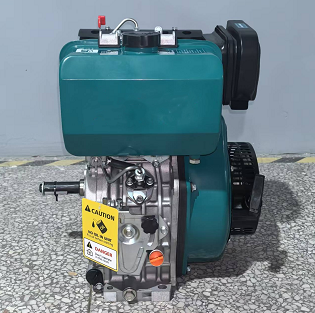
The most distinctive visual feature of these engines is the intricate array of fins cast into the cylinder block and cylinder head. These fins are not merely decorative; they are precisely engineered heat exchangers. As the engine runs, a forced-air cooling system, driven by a flywheel-mounted fan or a separate blower, directs a stream of air over these fins. The fins dramatically increase the surface area exposed to the cooling air, efficiently conducting heat from the combustion chamber and cylinder walls and dissipating it into the atmosphere.
The "FA" or "F" designation in models like 186FA(E) or 195F(E) typically indicates a "forced-air" cooling configuration. The shrouding around the cylinder is critical; it ensures the cooling air is channeled effectively over all finned areas, preventing hot spots. The engineering challenge lies in optimizing the fin geometry (depth, spacing, shape) and airflow pattern to manage the intense thermal loads, especially around the cylinder head and exhaust valve area, where temperatures are highest.
Decoding the Lineup: From 173F(E) to 195F(E)
The numerical sequence—173, 178, 186, 188, 192, 195—primarily denotes the engine's displacement in cubic centimeters. This progression reflects a scalable family of engines, where a larger bore and/or stroke provides increased power and torque output to suit different application demands. The "E" suffix commonly denotes an electric-start version, a significant convenience feature over manual recoil starting, especially on larger models.
173F(E) & 178F(E): These represent the smaller end of the spectrum. With displacements around 0.3 horsepower per cc (with variations based on design), they are compact power sources ideal for smaller water pumps, compact generators, light tillers, or as auxiliary power units. Their modest size and weight make them highly portable.
186FA(E) & 188FA(E): Occupying the mid-range, these engines offer a balanced increase in power for more demanding tasks. They are commonly found on mid-sized generator sets (3-5 kVA), larger water pumps for irrigation, concrete vibrators, and industrial air compressors. The "FA" explicitly highlights the forced-air cooling critical for sustained operation under load.
192FC(E) & 195F(E): These are the larger-displacement models in this common series, approaching or exceeding 400cc. They deliver higher power and, more importantly, greater torque at lower revolutions per minute (RPM). This makes them suitable for driving larger equipment such as high-capacity centrifugal pumps, heavy-duty welding generators, commercial lawn and turf equipment, and more robust construction machinery. The "C" in 192FC(E) may indicate a specific design variant, such as a governed speed type or a particular mounting configuration.
Operational Characteristics and Application Realm
Air-cooled diesel engines of this class are almost exclusively direct-injection, single-cylinder, four-stroke designs. Direct injection contributes to good fuel efficiency and reliable cold starting—a key diesel attribute. They are engineered to run at constant or variable speeds, often governed at industry-standard speeds like 3000 RPM for 50Hz generator applications (3600 RPM for 60Hz) or 1500 RPM for lower-noise, longer-life generator sets.
Their natural habitat is anywhere environmental resilience is key:
Agriculture: Tractor-mounted implements, irrigation pumps, grain augers.
Construction: Light towers, vibratory plate compactors, cut-off saws, small mixers.
Power Generation: Prime or standby power for remote telecom towers, construction sites, and rural homesteads.
Industry: As standalone power for remote equipment, marine auxiliaries, and material handling.
Considerations and the Path Forward
The design is not without compromises. Air-cooled engines typically run louder than their liquid-cooled counterparts, as there is no water jacket to dampen mechanical and combustion noise. Their cooling efficiency has a lower ceiling, which can limit maximum continuous power output compared to a liquid-cooled engine of similar size. They are also more sensitive to ambient temperature extremes and require clean intake air to prevent fouling of the cooling fins.
Today, the evolution of this classic design continues. Modern iterations of engines like the 195F(E) incorporate advanced fuel injection systems for lower emissions and better fuel economy, improved metallurgy for the fins and cylinders, and better balancing for reduced vibration. They are increasingly designed to meet stringent global emission standards (like EPA Tier 4 or EU Stage V for non-road engines), incorporating technologies like overhead valves, precise injection timing, and sometimes even simple exhaust after-treatment.
The 173F(E) to 195F(E) series of air-cooled diesel engines represent a timeless engineering solution. In a world increasingly drawn to complex, electronically managed systems, they stand as a testament to the enduring value of mechanical simplicity and adaptive design. They are not about peak horsepower or silent operation; they are about delivering dependable, self-contained power where it is needed most, with minimal fuss and maximum staying power. From powering a farmer's well in a distant field to keeping the lights on at a remote research station, these finned, puffing workhorses continue to prove that for many of the world's toughest jobs, air is all the coolant you need.