

Types of Off-Highway Diesel Engines Used in Tractors
Tractors are the workhorses of agriculture and construction, and their performance hinges on the diesel engines that power them. Unlike on-road vehicles, off-highway diesel engines are engineered for maximum torque, exceptional durability, and the ability to operate in harsh, dusty environments. This article provides a comprehensive overview of the primary types of diesel engines found in modern and legacy tractors, classified by their operational cycles, induction systems, fuel injection technology, cylinder configuration, and cooling methods.
1. Classification by Operational Cycle
Two-Stroke Diesel Engines
While relatively rare in modern agricultural machinery, two-stroke diesel engines have a historical presence in small, specialized tractors and industrial equipment.
Working Principle: Completes a power cycle with just two strokes of the piston (one up, one down), combining intake and exhaust functions. This allows for a power pulse every revolution, theoretically offering high power density.
Applications: Primarily found in older or very compact utility tractors, lawn mowers, and some industrial tractors.
Advantages: Mechanical simplicity, high power-to-weight ratio, and the ability to operate in any orientation.
Disadvantages: Lower fuel efficiency, higher emissions (particulate matter and NOx), and poorer lubrication control compared to four-stroke designs. Due to increasingly stringent emission regulations (Tier 4 Final/Stage V), their use in new tractors has been largely phased out in favor of four-stroke engines.
Four-Stroke Diesel Engines
This is the dominant and standard engine type in virtually all modern agricultural and construction tractors.
Working Principle: Operates on the classic Otto cycle: Intake, Compression, Power, and Exhaust. Air and fuel are managed in separate strokes, allowing for more precise combustion control.
Applications: Universal across all tractor segments, from compact 25 HP utility tractors to massive 600+ HP articulated four-wheel-drive (4WD) machines.
Advantages: Superior fuel efficiency, lower emissions profile, better low-end torque characteristics, and longer engine life. The design is inherently more compatible with modern emission control technologies like Exhaust Gas Recirculation (EGR) and Selective Catalytic Reduction (SCR).
Disadvantages: More complex valvetrain and lubrication system, heavier for a given displacement, and typically more expensive to manufacture.
2. Classification by Air Induction & Aspiration
Naturally Aspirated (NA) Engines
These engines rely solely on atmospheric pressure to draw air into the cylinders.
Characteristics: Simpler design with no turbocharger. The power output is limited by ambient air density.
Applications: Older generation tractors and small, low-power modern tractors (typically below 50 HP) where cost and simplicity are prioritized over peak power.
Limitations: Significant power loss at high altitudes and lower volumetric efficiency, resulting in a lower specific power output.
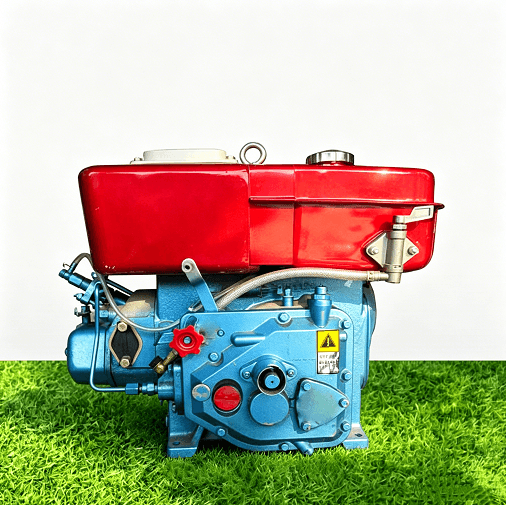
Turbocharged Engines
The industry standard for medium and high-horsepower tractors.
Characteristics: Uses a turbine driven by exhaust gases to force more air into the combustion chamber. This allows for a smaller engine displacement to produce significantly more power (a process known as "downspeeding").
Applications: The vast majority of tractors from 75 HP upwards. Essential for maintaining power at altitude and providing the high torque rise needed for heavy draft work like plowing.
Advantages: Dramatically increased power and torque density, improved fuel efficiency (better combustion with excess air), and compensation for altitude effects.
Turbocharged and Aftercooled/Intercooled Engines
An evolution of the turbocharged engine, critical for high-performance applications.
Characteristics: Incorporates a heat exchanger (aftercooler or intercooler) between the turbocharger and the intake manifold to cool the compressed intake air.
Benefits: Cooler air is denser, allowing for more fuel to be burned efficiently. This increases power output further, reduces thermal stress on engine components, and lowers the risk of knocking. It is a key technology for meeting emission standards without sacrificing performance.
3. Classification by Fuel Injection System
Mechanical Injection Systems
The traditional workhorse of diesel engines for decades.
Types: Include inline injection pumps, rotary/distributor pumps, and unit injectors. Fuel pressure is generated mechanically and timing is controlled by mechanical governors.
Applications: Found in tractors manufactured up to the early 2000s. Known for their robustness and ease of repair in the field.
Limitations: Limited ability to control injection timing and pressure with high precision, leading to higher noise, vibration, and emissions. Cannot meet modern emission norms without auxiliary systems.
Electronic Unit Injection (EUI) & High-Pressure Common Rail (HPCR)
The modern standard for clean, efficient power.
Electronic Unit Injection (EUI): Uses electronically controlled individual pumps for each cylinder. Offers better control than mechanical systems and was a transitional technology.
High-Pressure Common Rail (HPCR): The state-of-the-art system in modern tractors. It features a single high-pressure fuel rail supplying all injectors. Fuel pressure is generated independently of engine speed.
Advantages of HPCR: Enables multiple injection events per cycle (pilot, main, post), which drastically reduces noise ("diesel clatter") and NOx emissions. It provides superior fuel atomization, leading to better fuel economy and more precise power control essential for precision farming.
4. Classification by Cylinder Configuration & Displacement
The number of cylinders is directly tied to the tractor's size and intended use.
Cylinder Configuration | Typical Power Range | Applications & Characteristics |
|---|---|---|
2-Cylinder | 15 - 50 HP | Compact Utility Tractors. Simple, lightweight, cost-effective. Often found in older models (e.g., John Deere 2-cylinder "Johnny Poppers") or small modern orchard/vineyard tractors. Can produce noticeable vibration. |
3-Cylinder | 30 - 75 HP | Sub-Compact & Utility Tractors. Offers a good balance between smoothness and compact size. Very common in the modern small-farm segment. |
4-Cylinder | 50 - 180 HP | Mid-Range Row-Crop Tractors. The most common configuration globally. Provides an excellent compromise of power, smooth operation, and serviceability. Often turbocharged. |
6-Cylinder (Inline) | 120 - 400+ HP | High-Horsepower Agricultural & Construction Tractors. Used for heavy tillage, large-scale harvesting, and industrial applications. Inline-six engines are inherently balanced for smooth operation under heavy load. Often turbocharged and aftercooled. |
V-Cylinder (V6, V8) | 300 - 700+ HP | Large Articulated 4WD Tractors. Used when extreme power is needed in a shorter, more compact engine block. Less common than inline configurations in standard agricultural tractors but prevalent in heavy industrial and mining equipment. |
5. Classification by Cooling Method
Air-Cooled Engines
Mechanism: Relies on fins on the engine block and a large fan to dissipate heat directly into the air. No radiator or coolant is used.
Applications: Primarily in small, simple tractors and in regions with extreme climates (very hot or very cold) where water freezing or boiling is a concern. Brands like Deutz have a history of producing air-cooled industrial diesel engines.
Pros: No risk of freezing or coolant leaks, simpler maintenance.
Cons: Less precise temperature control, leading to higher thermal stress and noise levels. Unsuitable for large, high-output engines.
Liquid-Cooled (Water-Cooled) Engines
Mechanism: Uses a closed-loop system with a water/coolant mixture, water pump, radiator, and thermostat to regulate engine temperature.
Applications: The overwhelming standard for all modern tractors above 50 HP.
Pros: Superior heat dissipation, allowing for higher sustained power outputs and tighter emission control. Quieter operation and longer engine life due to stable operating temperatures.
6. Emission Standards & Future Trends
Off-highway diesel engines are subject to strict emission tiers (Tier 4 Final in the US, Stage V in Europe). This has driven the convergence of modern tractor engine design towards a specific archetype:
The Modern Standard Tractor Engine:
4-Stroke, 4 or 6-Cylinder
Turbocharged & Aftercooled
High-Pressure Common Rail Fuel Injection
Liquid-Cooled
Equipped with SCR & DOC/DPF Aftertreatment
Looking ahead, hybridization is emerging as a trend, particularly for tractors operating in sensitive environments (e.g., vineyards) or for applications requiring high transient power, where electric drive components can supplement the diesel engine to reduce fuel consumption and local emissions further.
In summary, the choice of an off-highway diesel engine in a tractor is a deliberate balance of power needs, operational environment, and regulatory compliance. While the core principles remain, the technology has evolved from simple, mechanically controlled air-cooled engines to highly sophisticated, electronically managed powerplants that are as clean as they are powerful.